Design & living
Hidden-compartment shelves: what to check before buying
Check usable space, installation, access and total cost before choosing a shelf with a concealed drawer or a freestanding alternative.
Read the article
Home and design · 8 min read
Stand in front of any bookshelf and ask a simple question: if a guest walked over, what would they pick up? A book, probably. The framed photo, to see who is in it. The little box with a lid, because a lid is an invitation. The speaker at the end of the shelf? Almost never. That small observation sits behind the best bookshelf decor ideas we know, and behind the way we design our objects. This guide covers both: how to style a shelf in a living room, a home library or above a desk so it looks calm and lived in, and how hidden storage can sit on that same shelf without asking for attention.
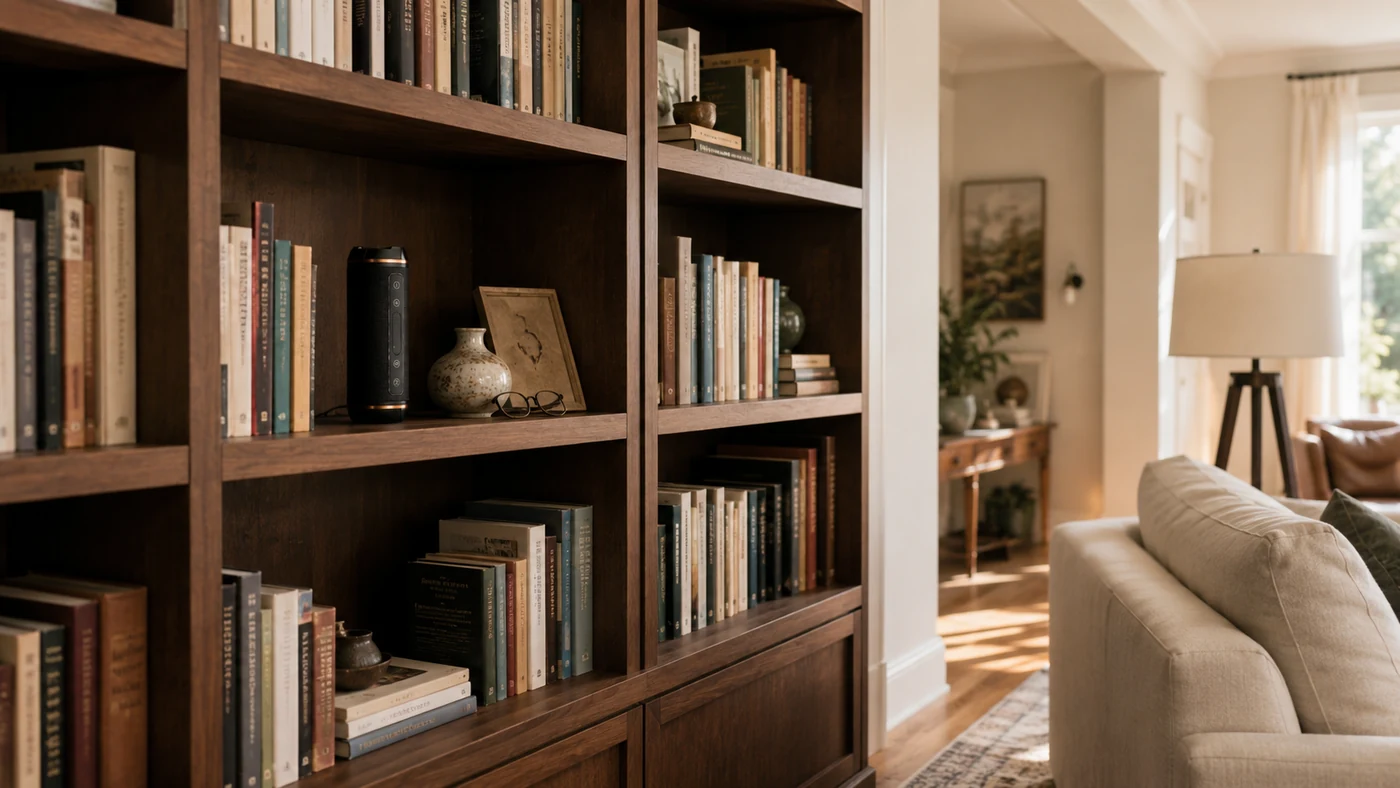
Every shelf holds two kinds of objects. Some invite a closer look: photographs, notebooks, souvenirs from a trip, anything that looks personal or unusual. Others are read in half a second and filed away: books standing in a row, a plant, a lamp, a pair of bookends, the speakers beside the television. The eye recognises them, decides it already knows what they are, and moves on.
Good shelf styling uses both. A few objects that catch the eye give a shelf its character. Many that simply rest give it calm. If everything on a shelf asks to be picked up, it feels busy, like a shop display. If nothing does, it starts to look like storage. The balance sits somewhere in between, and it happens to be the same balance that makes hidden storage work.
The living room shelf is the one everybody sees. It usually mixes books with whatever gathers around a television or a record player: remotes, chargers, speakers, a lamp. That mix is an advantage. Objects that look as if they belong to the music corner are expected there, so they blend in without any effort.
Start with the books. Group them in blocks instead of spreading a few across every shelf, and alternate upright rows with short horizontal stacks. A horizontal stack makes a natural plinth for a small object. Then add one or two pieces per shelf and leave some shelves partly empty. Empty space is what makes the rest look chosen rather than stored.
If the shelf sits near the TV or a turntable, a pair of speaker shapes at either end is about as ordinary as living room decor gets. Few people stop to wonder why there are speakers next to the music.
On a full wall of books, the books are the decor. Objects work as punctuation: a bookend at the end of a run, a small framed print leaning against the spines, a lamp on a middle shelf. One object every few feet is usually enough.
Keep the palette tight. On dark shelving, choose objects in dark or warm tones; on pale shelving, lighter ones. When colours and finishes repeat across the wall, the eye reads it as one composition and stops hunting for the odd piece out. That is the goal: a library that feels lived in, not curated item by item.
Height matters as well. Shelves at eye level get the most attention, so that is where the books and pieces you want people to notice belong. The top and bottom shelves are quieter, which makes them a natural home for things you would rather keep in the background.
A shelf above a desk or beside the bed is small and within arm's reach. It holds what you use every day, so it fills up fast. The rule here is fewer, smaller objects, each with a reason to be there: a lamp, a short stack of books, a plant that likes the light, a tray for keys and coins.
A small object shaped like a portable speaker fits naturally into this kind of space. Plenty of people keep one by the bed or on the desk. Next to a charger and a paperback, it reads as part of the everyday kit and nothing more.
If your shelves have drifted into clutter, this is the order we would follow. It works for a single floating shelf as well as for a full wall.
Once a shelf is styled, it becomes a good place for hidden storage, because people tend to take in a calm shelf as a whole rather than piece by piece. The idea is simple: keep a few things inside an object that already belongs in the room.
There are several ways to do it, each with its own trade-offs. The hollowed-out book is the classic, so familiar by now that it has become a bit of a cliché. A lidded box is easy, but a lid is exactly what curious hands open. Furniture and shelves with built-in hidden compartments offer more room, but they mean installation and a bigger purchase; we have separate guides on what to check before buying either.
Then there are objects shaped like familiar electronics, which is where we work. A speaker shape is useful precisely because it is so familiar. People see it, recognise it and move on.
A lock is honest about what it does. It tells everyone in the room that there is something worth protecting, and exactly where it is. For some things that is exactly right.
Camouflage works the other way round. It does not draw a line around your things; it places them inside something so ordinary that it attracts no particular attention. That is a quiet layer of privacy, not protection, and it will not stop a determined search. We would never claim otherwise.
So use each for what it does well. Important documents and high-value items deserve storage chosen for that job. Small personal things you simply want close and out of sight are where a design object with a hidden compartment makes sense. Luke and NIKO are design objects, not security products.
NIKO is our object for the bookshelf. It is shaped like a classic bookshelf speaker, the kind that sits beside the TV or between the books. It is not a speaker: there is no sound and nothing to plug in. With NIKO closed, the compartment is not visible, and inside it measures 87 mm wide, 97 mm deep and 105 mm high.
What makes it work on a shelf is that speakers come in pairs. One on its own can look slightly odd; two look like a stereo. So NIKO can be ordered together with NIKO Eco, an identical-looking twin with nothing inside, or as a pair of NIKO with a compartment on each side. It comes in two finishes, Cherry and Honey, so you can choose the one closest to your shelf.
Have something specific in mind? A custom insert can be made on request, as long as the object fits inside. Ask before you order and we will agree the details with you first.
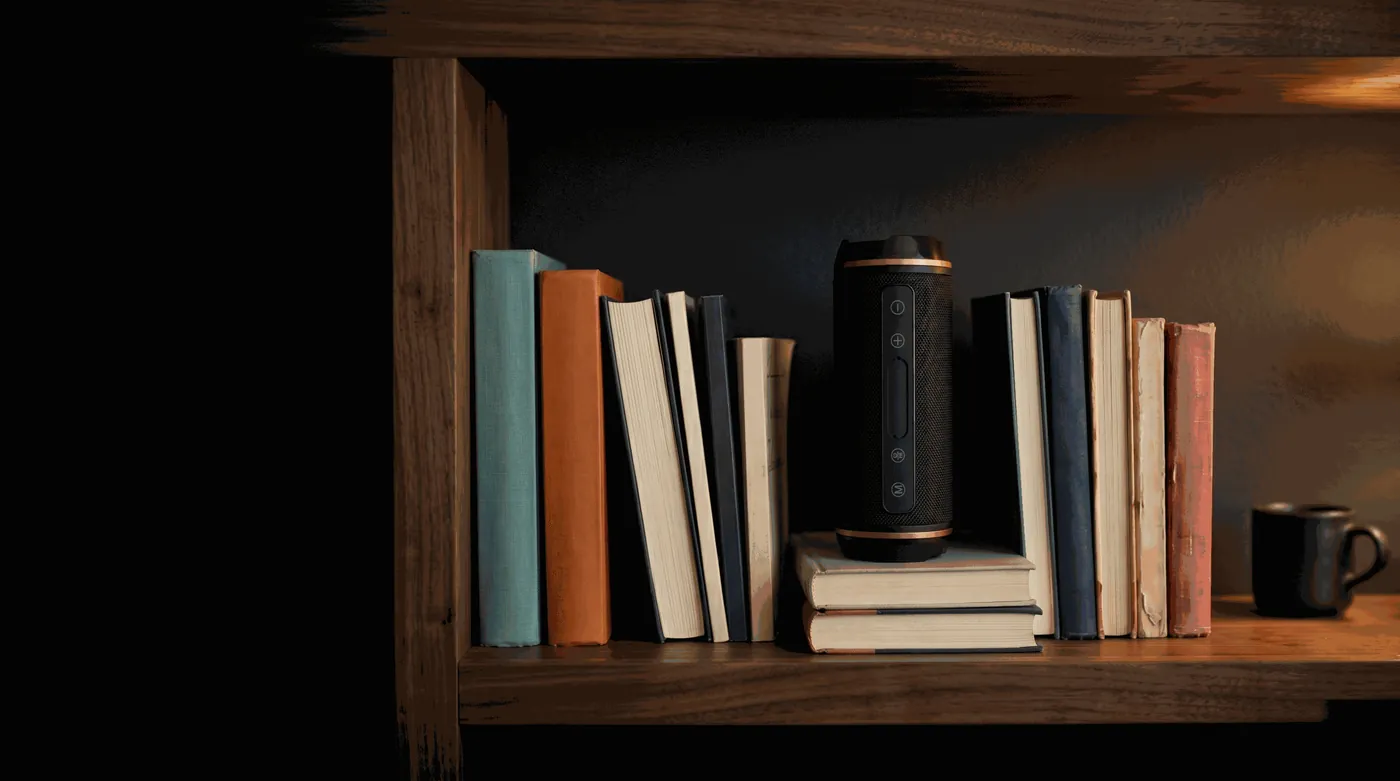
Luke is the smaller of the two, shaped like a portable speaker. It has a matte body and rings, copper-coloured on the black Luke in the photo above, and it comes in black, grey, blue and red. It is the kind of object you set down next to the books and stop noticing. It plays nothing. It keeps things.
The interior measures 48 × 126 × 17 mm, room for small personal things. Choose the open compartment, or a fitted interior for a supported Trezor or Ledger hardware wallet. If a hardware wallet is why you are reading, our article on the bitcoiner who never talks about bitcoin goes into more detail.
A few habits undo good styling, and most of them also make hidden storage easier to spot.
Start from the room, not the object. This table sums up the ideas above.
| Your space | What tends to work | For hidden storage |
|---|---|---|
| Living room shelf or media unit | Books in blocks, a lamp, speaker shapes near the TV | NIKO with NIKO Eco, or a pair of NIKO |
| Home library wall | Books first, an object every few feet, a tight palette | NIKO at the end of a run of books |
| Shelf above a desk | Fewer, smaller things you use every day | Luke |
| Bedside table or shelf | A lamp, a book and one object | Luke |
| Something specific that has to fit | Measure it before you choose | Ask us about a custom interior |
NIKO is made to order, and both Luke and NIKO ship to the US, Canada and Europe. If you need one by a particular date, for a move, a housewarming or a gift, tell us the date before you order and we will tell you honestly whether we can make it.
And if you are reading this because you are shopping for someone whose shelves already look perfect, our guide to a gift for the man who has everything may help.
Read the shipping information ↗
Group the books in blocks, add one or two objects per shelf, repeat a few colours or finishes and leave some empty space. Empty space is what makes the rest look intentional.
Objects that already belong there, such as speaker shapes near the TV, bookends or furniture with built-in compartments. The more ordinary an object looks in that room, the less attention it draws.
There is no fixed rule, but one or two per shelf, alongside the books, keeps most shelves calm. If a shelf feels busy, take one thing away before adding anything new.
Not on its own. Camouflage keeps things out of sight; it does not stop a determined search. Luke and NIKO are design objects, not security products.
No. They are shaped like speakers, but there is no sound and nothing to plug in.
VEKSU / LUKE
Add one quiet object to your shelf, the kind most people leave alone. Choose Luke's colour and interior.
Choose LukeContinue reading
Design & living
Check usable space, installation, access and total cost before choosing a shelf with a concealed drawer or a freestanding alternative.
Read the article
Design & living
Compare capacity, access, installation and everyday use when choosing furniture with concealed storage or a smaller portable object.
Read the article